
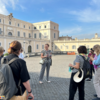
Group of adults standing in a Roman piazza

During the Roma Moderna course

Read through the descriptions below to learn more about the courses offered as part of the Adult Study Abroad Program! 

Base Program (Included for all participants).

Each participant will need to choose a Primary Focus when enrolling in the program. Primary Focus courses meet twice per week, off campus.

The following courses are included in the base program fee, and thus taken by all ASA participants.

Primary Focus Courses

Each ASA participant must choose one primary “study track” each semester which consists of their primary subject course. Each primary subject course meets twice per week at archaeological, cultural and historical sites throughout the city of Rome. The following study tracks / primary subject courses are offered in 2025:  

  • Roma Antica: Roma Antica: 
    This course offers an in-depth exploration of Ancient Rome through the lens of its physical remains—monuments, archaeological sites, and museum collections. Combining historical analysis with archaeological interpretation, students will investigate the rise and transformation of Roman civilization from its legendary founding through the imperial period and beyond. Special attention will be given to Rome itself as a living museum, where layers of history remain visible in its urban fabric. Key topics include the political and religious functions of monumental architecture, domestic and funerary spaces, public entertainment venues, and imperial propaganda. Through site visits  and critical readings, students will gain a nuanced understanding of how Rome's material culture reflects and shapes its historical narrative.
  • Roma Città d'Arte:  
    This immersive, site-based course invites students to explore Rome as a living museum, tracing the city's artistic legacy from the medieval era through the heights of the Renaissance to the grandeur of the Baroque. Through guided visits to churches, museums, and historic landmarks, students will encounter masterpieces by artists such as Raphael, Michelangelo, Caravaggio, and Bernini in the settings for which they were created. The course emphasizes close looking and historical context, offering a unique opportunity to experience the evolution of Western art where it was made and meant to be seen.
  • Roma Moderna: 
    Together with Temple Rome faculty, participants will explore sites relevant to the contemporary history and character of Rome. This exploration begins with the Risorgimento, or unification of Italy, and continues through World War I, Fascism, World War 2, and Postwar Italy.


Additional Base Program Courses
  • Italian Language & Culture: In addition to the primary subject course, all ASA participants are enrolled in an Italian Language & Culture course. The course meets three times per week, including two 90-minute classroom sessions and one 3-hour cultural lab off campus. Various language levels are offered each semester based upon enrollment and the results of the ASA Italian Placement Exam. 
    Course Description: One cannot fully begin to understand a new culture without first understanding the local language. In this course, learners will embark on an educational journey in which language and culture intertwine. Emphasis will be placed on the vocabulary and phrases most commonly used in every-day settings, and embedded “Italian Tutors” will allow learners to practice conversational skills with native speakers during each class meeting. Learners will put their newfound language skills to use in real-world settings during weekly Cultural Labs, designed to highlight key aspects of everyday Italian life and culture.  
  • Italian Film Seminar: Each participant will also have the opportunity to participate in a classroom film seminar focused on Italian cinema. The seminar meets once weekly on campus. 
    Course Description: In this seminar, “Italian Culture through Cinema,” we will delve into and share ideas, observations, experiences, and questions regarding relevant aspects of Italian society as portrayed in Italian films. Some topics pertaining to the historical, social, and economic developments of contemporary Italy are discussed, such as: fascism; the family; attitudes towards gender; political instability; rural poverty; the uneasy relationship between north and south; terrorism, organized crime and the mafia; and immigration.

Adult Study Abroad Seminar: Each participant will also have the opportunity to participate in a classroom discussion seminar focused on a rotating topic. The seminar meets once weekly on campus. 

In addition to the base program courses listed above, we also offer a series of elective courses for an additional fee. Elective courses typically meet once per week, off campus. Offerings may vary from one semester to the next, but check out some of our more popular electives below!

Elective Courses


  • Artists & Artisans:
    This course is intended to introduce participants to the rich and varied hand made tradition in Rome. Built on the banks of the Tiber River, and with direct access to the Tyrrhenian Sea, the city has been at the center of commercial activities since antiquity, with merchants and commerce spurring the economic growth of Rome. As a port city that saw the arrival of merchandise from all parts of the Roman Empire, and again in the later Middle Ages, with the rise of commercial activities throughout Europe,  tradesmen, pilgrims and voyagers brought their wares, or needed merchandise. Keys, locks, saddles, prints, books, papermaking, weaving, tailoring, leather crafting, mosaic and fresco work, woodwork, gilding, and more were the core of the handmade artisan output. Artistically, the Emperors, the Church and the aristocratic families, commissioned the well-known marvel of buildings, churches, monuments, and works of art, which made use of the able hand work of brick makers, marble carvers, mosaic and fresco artists. 
    By means of neighborhood walks and visits to local Roman artisans, we will explore the continuity of this artisanry. 
     
  • Rome Unveiled: 
    “…I could tell you how many steps make up the streets rising like stairways, and the degree of arcades’ curves,and what kind of zinc scales cover the roofs; but I already know this would be the same as telling you nothing. The city does not consist of this, but of relationships between the measurements of its space and the events of its past…” Calvino, I. (1974). Invisible cities (W. Weaver, Trans.). Harcourt Brace Jovanovich. P. 12

    The passage is part of Marco Polo’s descriptions of imaginary cities to Kublai Khan. In this section, Polo reflects that a city cannot be reduced to its physical measurements (steps, arcades, roofs) but is instead defined by the relationships between space and memory, history, and human experience. Calvino’s passage of Invisible Cities reminds us that Rome’s true essence lies in diversity. Its spaces are meaningful because they hold centuries of religious coexistence, conflict, and dialogue that account for the matter of this course.

    For instance, think of the Spanish Steps (Piazza di Spagna). Their importance isn’t in the number of steps but in centuries of encounters: artists sketching, lovers meeting, protests gathering. The steps are a stage for human stories. Students will walk through those steps to explore the historical roots of pluralism in the city, the role of the Catholic Church, and the presence of diverse communities in the city. The Mosque of Rome, one of Europe’s largest, is not defined by its domes and arches alone. It represents the arrival of new communities, the negotiation of identity, and Rome’s evolving pluralism. Its significance lies in the relationship between immigrant histories and the city’s fabric.

    Through site visits, readings, and discussions, the course highlights how religion intersects with migration, identity, and civic life in Rome.
     
  • Architecture of Modern Rome:
    Beyond the Classical, Renaissance and Baroque monuments of the Centro Storico lies the Rome that is lived-in by a majority of Romans and has been a great cauldron of experiments in housing and neighborhood design for over 150 years. Through neighborhood walks, building interior tours and plein air sketching or photography (no experience required), we will consider the relationship between the city’s historic center and its periphery as well as modern housing and urban design strategies as they help to synthesize the major transformations of the Italian Capital in the 19th, 20th and 21st centuries. We will discover how architecture is intimately connected to Italy’s self-perception, from its 19th Century transformation to a parliamentary monarchy, through fascism and its post-World War II aftermath; and onward to the city’s 21st Century development trends and architectural landmarks. All class meetings take place onsite at diverse locations within Rome’s public transport network, which learners will explore and navigate as an essential tool of life in the city. 
    ​​​​​​​
  • Studio Art(s):
    Rotating studio art disciplines are offered each year based on participant interest. To date we have run courses in Printmaking, Sketchbook, and Painting for our Adult Study Abroad students, though we offer courses in many more disciplines here at Temple University Rome for our general student body.