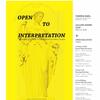

Temple University Rome is excited to host its seventh annual Black History Month throughout February 2026.
Temple University Rome is pleased to present Open to Interpretation: Material, Process, and the Design of Public Place, an exhibition by Tameka Baba, Garden Club of America | Prince Charitable Trusts Rome Prize Fellow in Landscape Architecture at the American Academy in Rome (AAR).
Presented in conjunction with Black History Month, the exhibition opens with a public reception at Temple University Rome’s Gallery on Tuesday, February 3, 2026, from 6:00 to 8:00 pm, and remains on view through Wednesday, February 25, 2026.
Open to Interpretation explores the city of Rome through a focused engagement with Piazza del Popolo, viewed through Baba’s artistic and design practice. The exhibition features prints, drawings, photographs, and tapestry—Baba’s primary medium—and develops organically through her ongoing dialogue with fellow artists and scholars at the American Academy in Rome.
The exhibition is accompanied by Open Dialogue, a series of public programs including two roundtable discussions and a weaving workshop. Each event centers on a curated theme and brings together invited speakers for interdisciplinary conversation. These programs take place on select Wednesdays during the exhibition period.
February 11 at 6pm - A Matter of Site with AAR Fellows Cory Henry, Heather Hart, and TJ Dedeaux-Norris
February 18 at 1pm –Texture Lab – Weaving Workshop with Tameka Baba
February 25 at 6pm – In the making with AAR Fellows Karen Lutksy, Sean Burkholder, Heather Scott Peterson, and Jennifer Bornstein.
Artist's Statement
“The beauty of design lies in its openness: there are no fixed right or wrong interpretations, only shifting lenses—personal, professional, and societal—through which we perceive and understand the world. This exhibition presents a body of work by landscape architecture educator and artist Tameka Baba, whose practice explores weaving and other textile-based processes as both method and metaphor for reimagining overlooked and forgotten landscapes. Embracing design as a living, evolving art form, Baba’s work responds to time, human presence, and natural systems, revealing landscapes as dynamic spaces shaped by interaction, memory, and care.
Visitors are invited to see, touch, and engage with an assortment of materials and participate in a series of open dialogues that blur the boundaries between art, landscape, and craft. Through tactile encounters and immersive forms, the work encourages reflection on new narratives of space, time, and environment—prompting a deeper consideration of our role in shaping, inhabiting, and stewarding the landscapes we share”.
Biography
Tameka Baba is an Assistant Professor of Practice in Landscape Architecture at The Ohio State University’s Knowlton School. Her work focuses on the reclamation and transformation of underutilized and abandoned urban spaces, with a deep commitment to creating places of communing for underserved communities. Her practice reimagines the traditional concept of the garden as a public, collective space.
By incorporating traditional textile crafts—such as weaving and sewing—into her design process, Baba bridges art, public engagement, and ecological design. This interdisciplinary approach underscores her commitment to innovative, community-driven landscape interventions that prioritize long-term stewardship and community care.
Baba is a Rome Prize recipient and is currently completing a 10-month fellowship at the American Academy in Rome. Her installation Site Unscreened was featured in the 2025 Venice Architecture Biennale. She was also the recipient of two inaugural fellowships: the Jane Blaffer Owen Foundation Creative in Residence Fellowship and the Knowlton School Midwest Landscape Lab Faculty Fellowship.